
Except for Robert Horatio, the soldiers of Richland County, IL returned home in 1865 and courted, resulting in a peaceful era of weddings and births. Robert, too, came home for a spell before re-enlisting in the Army in 1866. During that time, he began to court Margaret “Maggie” McWilliams. His cousin, Alex Kinkade, was keen on Maggie’s sister, Analiza.
Maggie and Robert corresponded during the years he fought the Indian Wars, and married shortly after his return to the community in 1869.
Alex Kinkade took his time, finally marrying Analiza McWilliams in 1870. Now Alex and Robert were brothers-in-law in addition to cousins.
There was a bit of a Baby Boom in the 70s…
Bob and Maggie Williams started out living with his parents, Ebenezer and Abigail, along with his four younger siblings, Joseph, Sarah, Willie, and Harry. He was working as a sawyer. Their first child, Fanny, was born in 1870. During the next decade, Maggie and Bob only had two more children: Ralph, in 1873; Clyde in 1877.
I was so proud to find this picture of the family! The baby at the back of the table is Fanny, so it would have been about 1871.

Robert’s older sister, Julia Walker Pixley, had a head start on the baby boom with Harry, born in 1866. In the 1870s, she contributed Arthur in 1871, and Stella in 1877. The Pixleys were residents of West Salem, IL, just a hair across the line in Edwards County. Mr. Pixley was a wheelwright.
The McWilliams sisters did their part. Sara McWilliams Carothers (married to William Carothers) added Frank in 1872, Mary Belle in 1877, and Susie in 1879. Belle McWilliams Elliott (married to William Elliot) contributed George in 1873, and Frank in 1877.
Alexander and Analiza McWilliams Kinkade had their first child, Anna Laurie, in 1871. It was five years later, on April 30,1876, that their second daughter was born. They named the little girl Olive Kate and the family called her “Ollie Kate”. She was my great-grandmother. Sadly, Analiza died 10 months later, and Ollie Kate forever felt like an orphan.
There were other deaths, as well: George McWilliams, Jr, and Joseph Kinkade, Jr. had died in 1874.
Alexander remarried in 1879, but the woman, Josephine Hill, was not from Richland County, nor can I see any connection she ever had to the area prior to her marriage to Alex. The two never had any children together, but for a while Anna and Ollie lived with them. Josephine was not maternal – Ollie described her as “the original wicked stepmother” – and both girls spent most of their time with their grandmothers. Anna stayed with the McWilliams Fam and Ollie was raised at the Kinkade household, particularly by her Aunt Hattie, who, at 25, was practically an old maid. They all regularly saw each other at church, school, and community events in nearby West Salem, and Parkersburg.
By the time of the 1880 census, Uncle Bob and Aunt Maggie were living with her parents, George and Catherine McWilliams, farming. It was 1889 when Maggie gave birth to Abigail, marking 12 years since her last child. As we have seen, that’s highly unusual and it makes one wonder if there were other babies born who did not survive.
The Baby Boom slowed down in the 1880s. Belle had two more, Charles, in 1881, and Susan, 1885. Robert and Maggie had their last child, Catherine “Kitty”, in 1892. His much younger brother, Harry, decided to get into the act and he and his wife started churning out babies every two years for next 14 years.
Over the course of a decade, all three of the patriarchs passed on: George McWilliams, died in 1881; Ebenezer Walker in 1889; Joseph Kinkade in 1891.
By the 90s, the babies of the 70s were young adults and the Civil War Vets were the elders. Some of the older generation had moved on – James Ruark and his family moved to Kansas and John Walker was farming down near Harrsiburg; All of the older Kinkade girls had married and moved out west.
Robert had spent the last thirty years raising his family, struggling at times, other times flush. I believe they lost several babies during those years, not an easy life. Always, he dreamed of returning to the mountains and the plains that he’d seen during the Indian Wars. His stories described lakes so full of fish that they’d jump into your frying pan, deer so plentiful that you did a favor by hunting them.
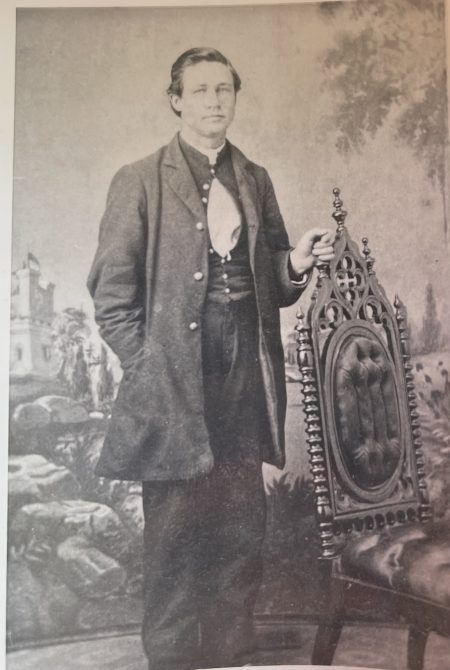
After his father died (in 1889), and following the birth of his last child (in 1892), Robert Horatio began to make a plan. He craved wide open spaces and felt his children and grandchildren would be better off away from the crowded family farms in Illinois. He had long dreamed of returning to Big Sky Country he’d glimpsed in his younger years.
Sometime during that decade, he pulled together his family and began to lay out his scheme…
They should pull up stakes and homestead.
His stories convinced them – his brothers, sisters, in-laws, and cousins – that true freedom and the American Dream was 1,200 miles away in North Dakota.
Stay tuned…

 Family Stories