Posted in The Robert Horatio Walker Story

Part 5 – Epilogue

So what happened to Robert Horatio and his band of Pioneers?

Right off the bat, in 1902, they were petitioning for a school for their children.
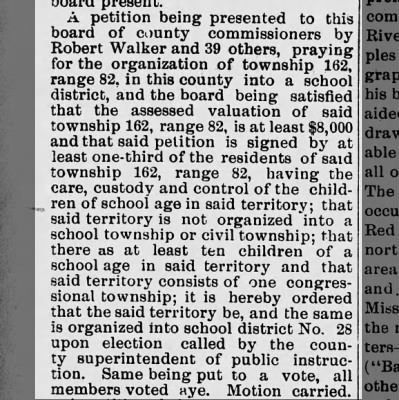
Robert and Maggie’s two youngest daughters, Gail and Kitty, were 10 and 8-years-old respectively when the family settled in Sherman Township. Over the next decade, their sons, Clyde and Ralph, added eleven more babies; daughter, Fanny, contributed four. Bob’s brother, Harry, brought three kids, 6-4-2 when they arrived, and four more were born in ND. Schools were a natural priority for the family!

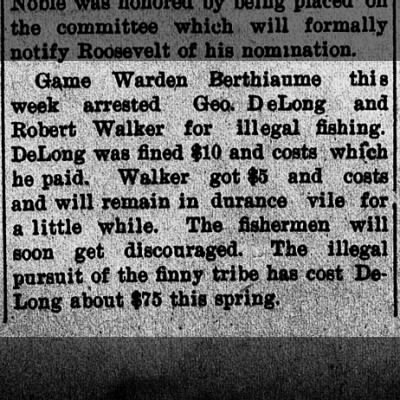
Uh-Oh, In 1904, Robert was fined for illegal fishing. It says he was in “durance vile” – an old term that means hard labor! Honestly, he must have gotten a little aggressive with the game warden. I can imagine that he would consider a fishing license an unacceptable infringement on his freedom… This article refers to the illegal pursuit of the “finny tribe”, which is a Scottish phrase for fish! Very colourful!
Following the 1904 death of her husband, Robert’s older sister, Julia Pixley, came to live with the clan. Her mother, Abigail, was still alive, living with her sister, Sally Carothers, and her son, Arthur, and daughter, Stella, were getting knee-deep in kids – Arthur had six!
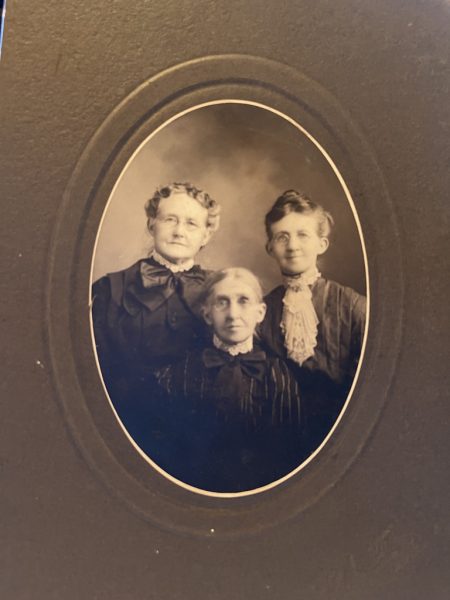
Sally, Julia, and their mother, Abigail

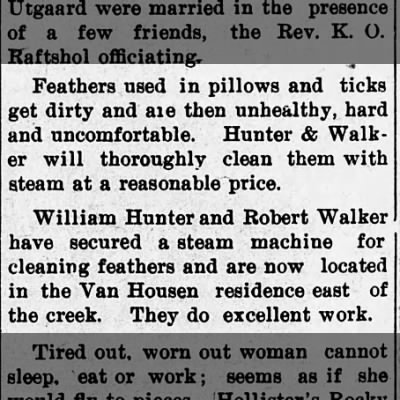
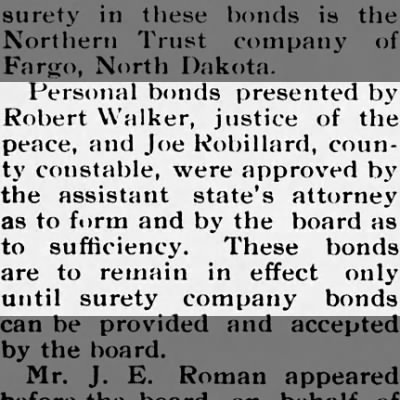
In 1905, he and a buddy started a new business, Hunter & Walker, to steam and clean feathers used in pillows and ticks. During those years, he was also a justice of the peace.
No doubt that the group were pleased when the Northern Pacific Railroad added a spur and built the town of Antler just five miles south of their Sherman Township homesteads.
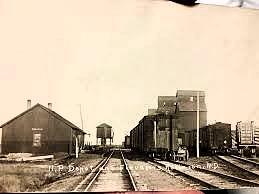
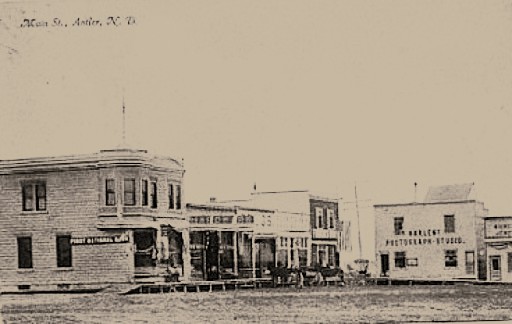
The Antler town-site was owned and plotted by the Tallman Investment Company in May of 1905, and by December of that same year, there were 40 businesses in Antler. The residents have had telephone service since 1906. That doesn’t sound all that primitive, does it?
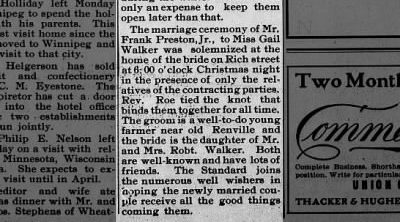
In 1906, Maggie and Robert’s daughter, Gail, married, getting a nice little write-up in the Bottineau Courant.
Robert’s mother, Abigail Reed Walker, passed away in 1908. Maggie’s mother, my great-great-great-grandmother, died in 1909, 94-years-old. Both of those remarkable women had been pioneers as children, and again as elders. Respect.

By 1910, the group looked a lot different. Sometime before then, Bob’s Brothers, Joseph and Harry, moved their families to Ft. McLeod, Alberta Canada.

Sister Sally Carothers, and her family moved to Boulder, Colorado.

Julia Pixley’s daughter, Stella, moved to Montana.

Maggie’s sister, Belle Elliott, and her family had migrated to Medicine Hat, Canada, in 1908.

Julia’s son, Harry Pixley, moved back to West Salem early on, marrying and running a repair shop there.

Robert and Charley Kinkade both returned to the farm in Richland County, though they maintained their claim in Sherman Township for many years.

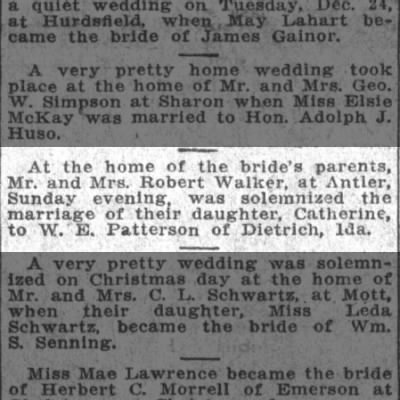
Robert and Maggie’s youngest daughter, Kitty, married and moved to Deitrich, ID in 1912.
In 1913, the old soldier made a trip to Gettysburg to commemorate that battle.
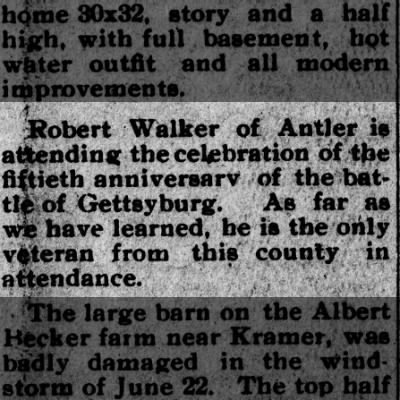
The 50th anniversary of the Battle of Gettysburg, known as the “Great Reunion” or 1913 Gettysburg Reunion, was a historic four-day event from June 29 to July 4, 1913, in Gettysburg, PA. Over 53,000 Union and Confederate veterans, with an average age of 72, met to reconcile, marking a peaceful, symbolic end to the conflict. There is an archive of pictures and interviews of the veterans that is fascinating. It must have been an emotional event for all.

In 1916, my most illustrious shirt-tail relative, Robert Horatio Walker, passed on, aged 70 years. He packed a lot of living into those years.

After her husband’s death, Maggie McWilliams Walker, (my 2x great grandaunt) moved to Idaho to live with her daughter, Kitty, where she died in 1918.
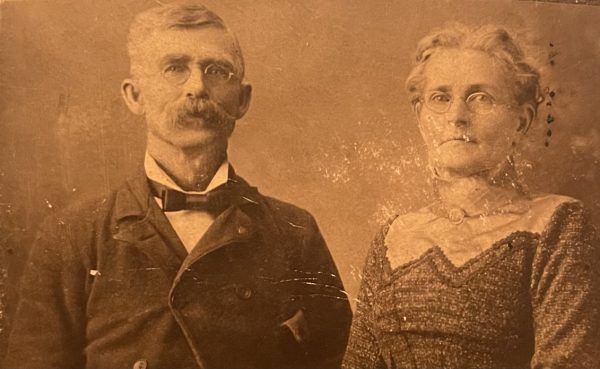
Robert Horatio and Maggie McWilliams Walker

It was a grand scheme, wasn’t it? And what better did they have to do but build a community in a new land? What a dream!

The folks who remained in Antler for the rest of their lives, or until they got so old they had to go live with their children, were Robert’s sons, Ralph and Clyde, daughters, Fanny and Gail, and nephew, Arthur Pixley

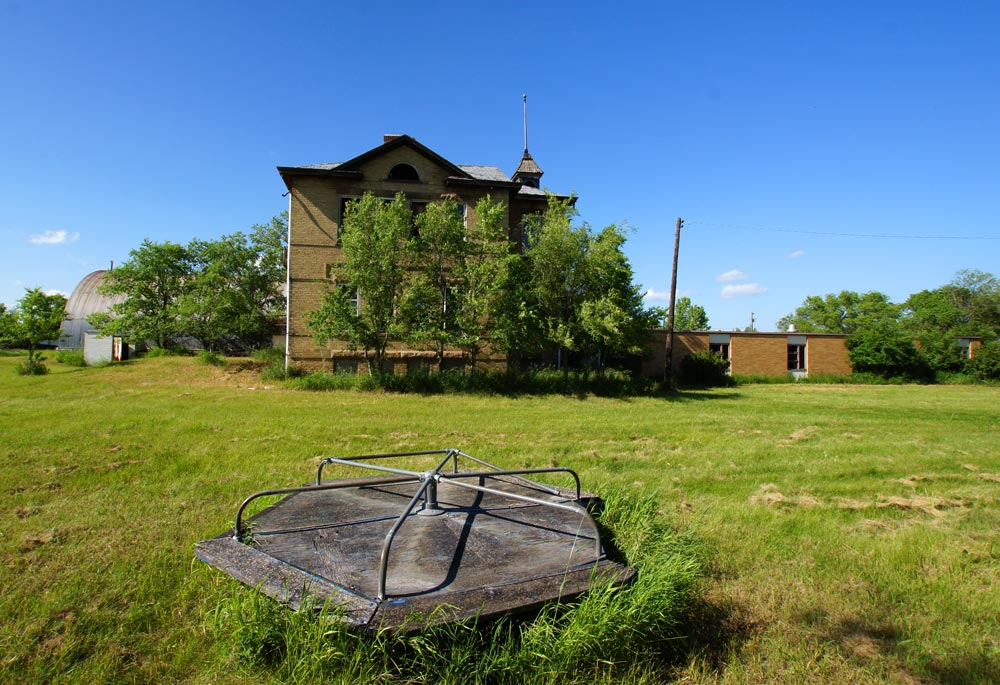
These days (2026) the population of Sherman Township, ND is 47. Antler’s population is 22.
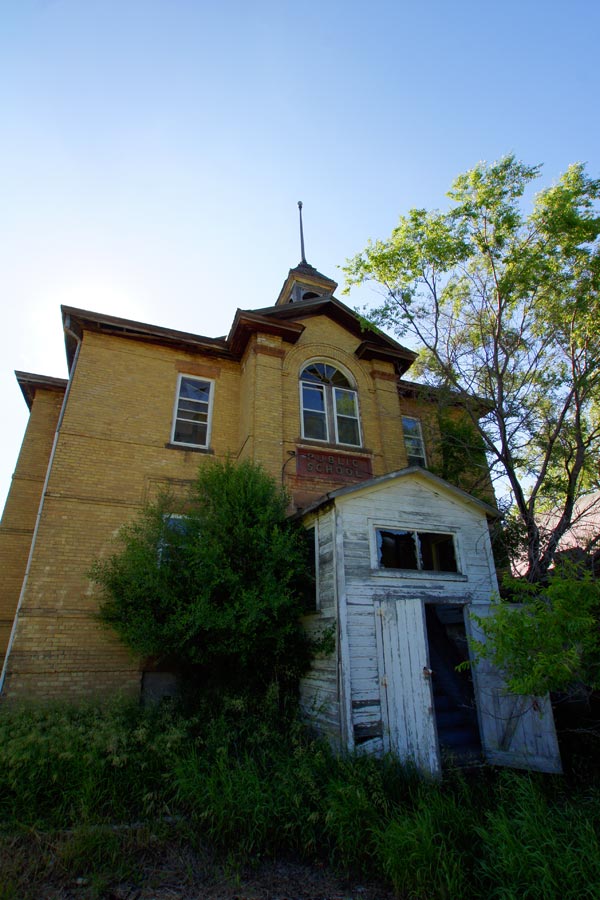
Their historical society is trying to do some preservation, but it’s pretty much a ghost town.

It seems even the ghosts have left, hanging out here with me, unveiling their story.

It has been my honor to share it with you.

Peace
Posted in The Robert Horatio Walker Story

Part 4 -1898-1901

The Homestead Act of 1862 was a U.S. law that allowed any adult citizen, or intended citizen, to claim 160 acres of federal land for a small fee, with the requirement to live on the land, build a home, and farm it for five years before receiving ownership.  The Dakota Territory was divided into North and South in 1889, and State officials wanted to attract settlers. They spread pamphlets and newspaper stories that painted a wonderful picture of North Dakota. They sold the idea that the land was like a garden, and free is the best price.

That must have appealed to the old soldier, Robert Horatio Walker. He had started out living with his parents in the house he was born in, working as a sawyer to feed the family. When George McWilliams died in 1881, he and the family had moved in with Catherine, and were farming. He and his cousins were well-respected citizens, hard-working and devout. But during his years in the regular army, fighting in the “Indian Wars”, he had no doubt glimpsed the spectacular. wide-open landscape of the Northern Prairies. All those years, he schemed to return. A born leader, he pulled together his children, his siblings, and his cousins and they began to plan their move.

They were nearly set to go in 1898, when Alexander Kinkade died suddenly in April. He and his brothers, Robert and Charles, were part of the group and the loss hit the family hard. Just as they were recovering, their mother, Robert Horatio’s aunt, and my 3x great-grandmother, Mary Ann Walker Kinkade passed away in September, at the venerable age of 80. She, too, may have been planning to move.

These developments slowed them down, but by 1899, the band of pioneers set off: Robert Walker, his two sons, Clyde and Ralph, son-in-law, Madison Wehrly, brothers, Joseph and William Walker, brother-in-laws, William Carothers and William Elliott, nephews, Arthur and Harry Pixley, nephew-in-law, Marion Barnhart, and cousins, Charley and Robert Kinkade, traveled to Sherman Township, Bottineau County, North Dakota.

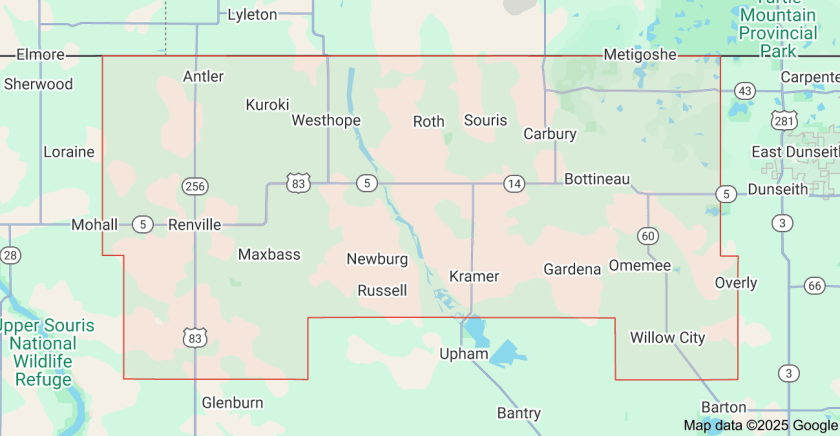
Bottineau County, ND, is at the very tip-top of the state, along the Canadian border, near the Turtle Mountains. This part of North Dakota was fertile prairie and known for growing wheat. Westhope was the nearest train depot, about 10 miles from their homesteads, which were nearer Antler.

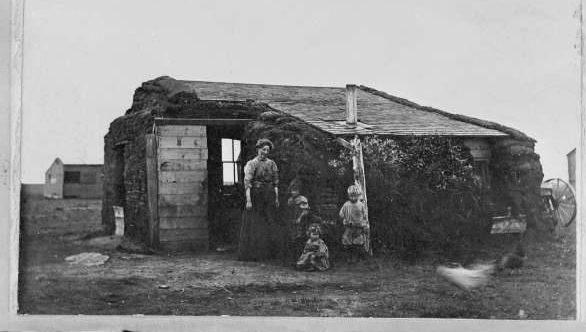
Each of the men filed homestead papers in Westhope for parcels in Sherman Township. Returning to Illinois for the winter, it was Spring of 1900, when they brought back machinery, household goods, and livestock. They built a sod shack that had one big room with curtains to divide it into separate rooms and the thirteen men worked out of that throughout 1900-1901.

These guys were no spring chickens…well, some of them were, but this was some rough living in a place known for its below-zero temperatures in the winter.

A sod house from around the time these pioneers were pioneering.

By the Spring of 1901, every family had a house. Down in Illinois, the McWilliams Farm, along with the Walker property, was sold, most of the Kinkade acres were sold, and the rest of the clan moved in by that Fall, including Robert’s mother, Abigail Reed Walker,73, and Maggie’s mother, Catherine Morrison McWilliams, 84.


Back in Richland County, IL, that Spring, Cousin Julia Walker Pixley and Aunt Hattie Kinkade Hall (and their husbands), both living in West Salem, IL, were all who were left of my great-Grandmother’s family. Her Uncle Bob and Aunt Maggie had urged her to come along with them, but Ollie Kate Kinkade (who had changed her name to Kathleen in 1898) had opted to continue living with Aunt Hattie and teaching music.

It’s a Good Thing that she stayed behind or I wouldn’t be here to tell their story. On April 16, 1901, while the pioneers were moving into their new houses, she married my great-grandad, Ben L. Mayne.

It was around 1995 when I mentioned to my grandaunt Bernie, 92 at the time, that her mother’s family was very small. She then told me a story her mother had told her, best she could recollect, that my great-grandmother had a very large, close family, but they had all “up and left”, gone “somewhere out west”. She had heard stories from her mother regarding her Aunt Maggie, and remembered meeting her granduncles, Charley and Robert Kinkade. It was decades later, after seeing the picture, that I was able to put the story together with Uncle Bob Walker.

And what happened to Robert Horatio and his band of Pioneers?

Stay tuned…

Posted in The Robert Horatio Walker Story

Part 3 – 1869-1898

Except for Robert Horatio, the soldiers of Richland County, IL returned home in 1865 and courted, resulting in a peaceful era of weddings and births. Robert, too, came home for a spell before re-enlisting in the Army in 1866. During that time, he began to court Margaret “Maggie” McWilliams. His cousin, Alex Kinkade, was keen on Maggie’s sister, Analiza.

Maggie and Robert corresponded during the years he fought the Indian Wars, and married shortly after his return to the community in 1869.

Alex Kinkade took his time, finally marrying Analiza McWilliams in 1870. Now Alex and Robert were brothers-in-law in addition to cousins.

There was a bit of a Baby Boom in the 70s…

Bob and Maggie Williams started out living with his parents, Ebenezer and Abigail, along with his four younger siblings, Joseph, Sarah, Willie, and Harry. He was working as a sawyer. Their first child, Fanny, was born in 1870. During the next decade, Maggie and Bob only had two more children: Ralph, in 1873; Clyde in 1877.

I was so proud to find this picture of the family! The baby at the back of the table is Fanny, so it would have been about 1871.

left-right: my 3x great-grandmother, Catherine McWilliams; my 2x great-grandaunt, Maggie McWilliams Walker, holding Fanny, and her husband, Uncle Bob Walker; Bob’s mother, Abigail Walker; Maggie’s sister, my 2x great-grandaunt, Belle McWilliams.

Robert’s older sister, Julia Walker Pixley, had a head start on the baby boom with Harry, born in 1866. In the 1870s, she contributed Arthur in 1871, and Stella in 1877. The Pixleys were residents of West Salem, IL, just a hair across the line in Edwards County. Mr. Pixley was a wheelwright.

The McWilliams sisters did their part. Sara McWilliams Carothers (married to William Carothers) added Frank in 1872, Mary Belle in 1877, and Susie in 1879. Belle McWilliams Elliott (married to William Elliot) contributed George in 1873, and Frank in 1877.

Alexander and Analiza McWilliams Kinkade had their first child, Anna Laurie, in 1871. It was five years later, on April 30,1876, that their second daughter was born. They named the little girl Olive Kate and the family called her “Ollie Kate”. She was my great-grandmother. Sadly, Analiza died 10 months later, and Ollie Kate forever felt like an orphan.

There were other deaths, as well: George McWilliams, Jr, and Joseph Kinkade, Jr. had died in 1874.

Alexander remarried in 1879, but the woman, Josephine Hill, was not from Richland County, nor can I see any connection she ever had to the area prior to her marriage to Alex. The two never had any children together, but for a while Anna and Ollie lived with them. Josephine was not maternal – Ollie described her as “the original wicked stepmother” – and both girls spent most of their time with their grandmothers. Anna stayed with the McWilliams Fam and Ollie was raised at the Kinkade household, particularly by her Aunt Hattie, who, at 25, was practically an old maid. They all regularly saw each other at church, school, and community events in nearby West Salem, and Parkersburg.

By the time of the 1880 census, Uncle Bob and Aunt Maggie were living with her parents, George and Catherine McWilliams, farming. It was 1889 when Maggie gave birth to Abigail, marking 12 years since her last child. As we have seen, that’s highly unusual and it makes one wonder if there were other babies born who did not survive.

The Baby Boom slowed down in the 1880s. Belle had two more, Charles, in 1881, and Susan, 1885. Robert and Maggie had their last child, Catherine “Kitty”, in 1892. His much younger brother, Harry, decided to get into the act and he and his wife started churning out babies every two years for next 14 years.

Over the course of a decade, all three of the patriarchs passed on: George McWilliams, died in 1881; Ebenezer Walker in 1889; Joseph Kinkade in 1891.

By the 90s, the babies of the 70s were young adults and the Civil War Vets were the elders. Some of the older generation had moved on – James Ruark and his family moved to Kansas and John Walker was farming down near Harrsiburg; All of the older Kinkade girls had married and moved out west.

Robert had spent the last thirty years raising his family, struggling at times, other times flush. I believe they lost several babies during those years, not an easy life. Always, he dreamed of returning to the mountains and the plains that he’d seen during the Indian Wars. His stories described lakes so full of fish that they’d jump into your frying pan, deer so plentiful that you did a favor by hunting them.

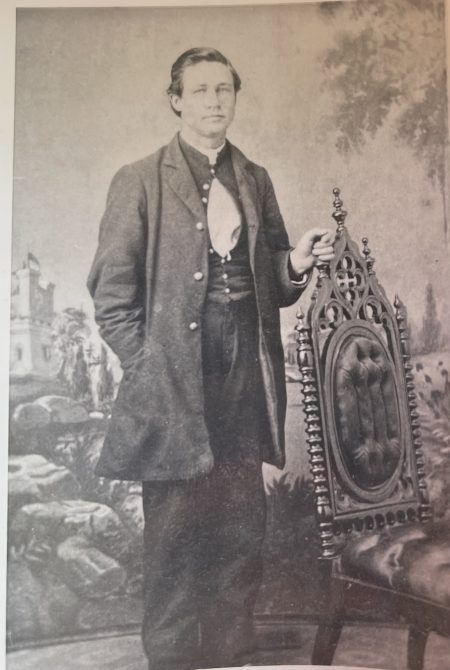
Robert Horatio Walker, around 1880

After his father died (in 1889), and following the birth of his last child (in 1892), Robert Horatio began to make a plan. He craved wide open spaces and felt his children and grandchildren would be better off away from the crowded family farms in Illinois. He had long dreamed of returning to Big Sky Country he’d glimpsed in his younger years.

Sometime during that decade, he pulled together his family and began to lay out his scheme…

They should pull up stakes and homestead.

His stories convinced them – his brothers, sisters, in-laws, and cousins – that true freedom and the American Dream was 1,200 miles away in North Dakota.

Stay tuned…

Posted in The Robert Horatio Walker Story

Part 1- 1818-1860

It was this cabinet card that started me wondering about my great-grandmother’s family.

The people were identified on the back in her distinct cursive: l-r: Grandfather Kinkade (my 2x great-grandfather); Uncle Robert Kinkade, of the St. Louis Kinkades (Joe’s brother); Uncle Robert Kinkade (Joe’s son); Kathleen Kinkade (my great-grandmother); Uncle Bob Walker; Uncle Charles Kinkade; Grandmother Kinkade (my 2x great-grandmother).

It’s so nice to have photos with identification! It gave me a boost with the Kinkade tree, but who was this Uncle Bob Walker and how did he fit in? That search has led me 1000s of miles and back again.

Robert Walker was the nephew of the lady sitting in the front-right of the picture, identified as “Grandmother Kinkade”, aka Mary Ann Walker Kinkade, so he was actually Kathleen’s first cousin once-removed. But…he was married to Kathleen’s mother’s sister, Maggie McWilliams Walker, so he was also her uncle. This Uncle/Cousin, Robert Horatio Walker, lived quite a life! I’m here to tell his story…

Let’s meet the Kinkade/McWilliams/Walker families who worked, played, worshiped, and loved in Richland County, Illinois, in the 19th century.

Illinois became a state, carved out of the Northwest Territory, in 1818. That same year, the Methodist Episcopal Church assigned two Circuit riders, Shadrach Ruark, Sr. and Joseph C. Reed to Southeast Illinois, around 10 miles west of the Wabash River. The two preachers brought their families, and bought land to settle and farm just south of the stagecoach road that they’d followed from Ohio.

Current map of Richland County, Illinois. From 1818-1841, this area was Edwards County, which is now at its southern border. See Calhoun (formerly Fairview) and Parkersburg.

The Reverend Ruark platted the community of Fairview (now Calhoun), and built a church there. The community grew quickly with stores, blacksmiths, homes, and even a hotel. While it was not officially organized under village government, the community of Fairview became well-known.

It was about 1830 when John and Julia Walker and family arrived from Ohio. Honestly, there were several families of Walker who arrived around that same time, forming a bit of a commune around the Fairview area. John and Julia bought acres near Fairview and settled into farming. Theirs was a blended family, as both were widowed at some point. I’ve not been sure about whose is whose in the group, but it included James Newell, 13; Elizabeth, 24; Sarah 19; Ebenezer, 15; and Mary Ann, 13, and James Walker, 7.

Next to check into the county were Joseph and Margaret Kinkade, Irish immigrants who had stepped off the boat just four years earlier. While still in Pennsylvania, Joseph and Margaret had their first child, Susan. They, too, had family already settled in the area, and the little family arrived in 1837, and started cranking out babies: Margaret, 1837; Elizabeth, 1839; Matilda, 1841; Alexander, (my 2x great-grandfather) 1845; Martha, 1848; and Joseph, 1850. That’s eight babies in 14 years.

Meanwhile, Ebenezer Walker married the Reverend Reed’s daughter, Abigail, in 1841. They started their family in 1843 when their daughter, Julia, was born, followed by their son, Robert Horatio, in 1846; Joseph, 1849; Sarah, 1852; John, 1857; Harry, 1860.

Ebenezer’s sister, Mary Ann, married the Reverend Ruark’s son, Milton, in 1844. They had a son, James, in 1845. Tragically, Milton died in 1847.

It was 1848 when George C. McWilliams and his wife, Catherine, arrived to farm land that was just down the road from the Kinkades and Walkers. There were already seven children in the family, as the couple was in the habit of having babies every two years. Their ages upon arrival from Pennsylvania: Philip, 14; George, Jr., 12; David, 10; Sarah, 8; Nancy, 6; Mary Elizabeth, 4; and Ann Eliza, (my 2x great-grandmother) was 2. Their daughter, Margaret “Maggie”, was born in 1850, and Catherine had twins, Hugh and Hannah Isabelle (later called Belle) in 1853. There may have been more, but I find no record of them surviving to adulthood, so we’ll stop at ten.

1850 brought hard times to the community. Ebenezer and Mary Ann’s parents, Julia and John Walker, died within 18 hours of each other, possibly from milk sickness, a disease that comes from drinking milk from cows that ate the toxic white snakeroot plant. There was something going around that year, for sure. The McWilliams Family lost two daughters, Nancy, 8, and Mary Elizabeth, 6, and Margaret Kinkade, Joseph’s wife, also died, leaving Joseph with seven! children, including six-month-old, Joseph, Jr. The whole community was in mourning.

It wasn’t long before Joseph remarried. He wed the widow Mary Ann Walker Ruark in 1851. Mary Ann’s son, James Ruark, was the same age as Joseph’s son, Alex, and he was blended right in, as along came four more babies: Harriett, 1852; Robert, 1854; and Charles, 1856; John, 1861 (died 1862). That’s a grand total of twelve children in the Kinkade household.

The new generation – about 30 of them! – grew up together, attending school and church together, and working on the family farms. These were Scots-Irish folk, and they sang, played stringed instruments (eventually pianos), and danced a fierce jig. The community grew, sharing the happiness and grief of life in those years.

Along came that pesky Civil War…

Stay tuned…

Posted in Photographs

Look at this photograph…

I have folders and folders of research on my dearly departed family members, so naturally thought I’d seen it all, so to speak. Just this week, though, I have come across a picture online that has really caught my fancy.

The setting is somewhere in Madison Township, Richland County, IL around 1872. I am intrigued by the table setting, lace cloth and pitchers of water. The grass is rather high, so it’s bound to be summertime, but the women are dressed warmly (as they were wont to do in those days), so maybe spring or fall.

A moment caught in time…A memory that is now shared, 155 years later…

l-r: ?Catherine McWilliams; Margaret McWilliams Walker, holding Fanny Walker; Robert Horatio Walker; Abigail Reed Walker; ?Hanna Isabelle “Bell” McWilliams. around 1872, near Parkersburg IL

The people were partially identified on ancestry and I felt a little thrill as I saw that my great-great-grandaunt, Margaret Jane McWilliams Walker, called Maggie, is the lady in the center of the picture, holding her daughter, Fanny, who is about two. The gentleman next to her I recognized right away as her husband, Robert Horatio Walker, but I’d never seen a picture of the lady next to him, who is identified as his mother, Abigail Reed Walker. The other two ladies looked familiar to me, as I have seen them in some of my unmarked portraits, but I had to do my due diligence to flesh them out.

Still, I’m not sure, but I think that the woman on the left is Aunt Maggie’s mother, my great-great-great grandmother, Catherine Morrison McWilliams. Going on around the table, on the far right is another of Catherine’s daughters, my 2x great-grandaunt, Hanna Isabelle “Bell” McWilliams, about 17 at the time of this picture–or that’s my best guess, for now…

The Walker/McWilliams Family Saga is rich with color, but I keep finding more info! I think I’ve got it all together now, so we should have the whole story soon. I’ll tell you this: These were some Strong Women….so glad to see their almost-smiling faces…

Stay tuned…

Posted in All Saints and Souls, Dia de la muertos

Family Reunion

Walking, I am listening to a deeper way. Suddenly all my ancestors are behind me. Be still, they say. Watch and listen. You are the result of the love of thousands. 
—Linda Hogan, Dwellings 

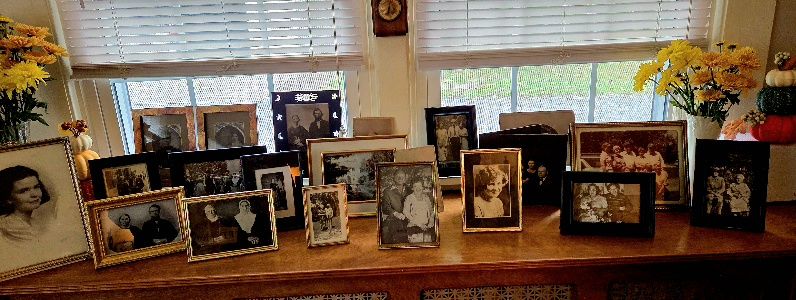
It took me two days to get the ofrenda arranged just right, but I was beginning to re-arrange it when my first guests began to arrive for our Halloween Party.

I felt the four of them smiling, looking over my shoulder at their photographs, framed and fresh to this gathering. Since last year’s celebration of All Saints and All Souls, I had inexplicably acquired photos of two sets of great-great-great grandparents. One was a daguerreotype in a stack of stuff my brother brought me, and the other I had found on Ancestrydotcom. The couples had, in life, been best friends; their children had married and they shared the same grandchildren.

I have written about my 3x great-grandfather, Benjamin Franklin Mayne, fairly extensively, but had only alluded to my 3x great-grandparents, Eliza and Orlando Harris, parents of Emma Eliza Inlow Mayne, my 2x great-grandma. If you’ve seen any of my posts relating our visits to the Emory Chapel Cemetery, you couldn’t miss their obelisk headstone. Those visits have served to attract these family members to join in the celebration.

Eliza Jane and Orlando Harris, around 1860
B.F. and Frances Mayne, around 1860

I am so happy to host them, and acknowledge that it is no accident that I found those pictures after 150 years. Their spirits are mingling with other relations that are more familiar to my altar.

Their children, my great-great-grandparents…

More 2x great-grandparents, parents of my beloved “Grandmother” Mayne (who was actually my great-grandmother). Her mother, Analiza, died when Grandmother was six months old and her grandmother, Catherine McWilliams, took a large hand in raising her. Her father’s family, the Kinkades, also were there for her…

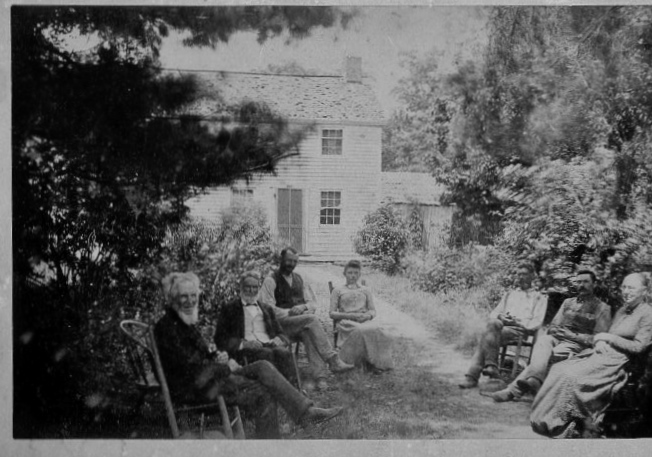
It looks like it was a hot day in Richland County, IL when the traveling photographer came by The Kinkade Farm and found the family relaxing in the shade…

3x great Joseph Kinkade, his brother, Robert (of the St. Louis Kinkades), Joe’s son, Charlie; Joe’s grand-daughter, Kathleen; nephew, Robert Horatio Walker; Joe’s son, Robert; and 3x great Mary Walker Kinkade.

I love – and feel the love – of them All…

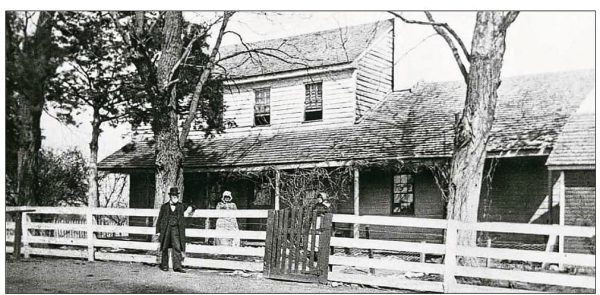
Adam and Catherine Mayne at their stagecoach stop, Travelers’ Rest by A. Mayne
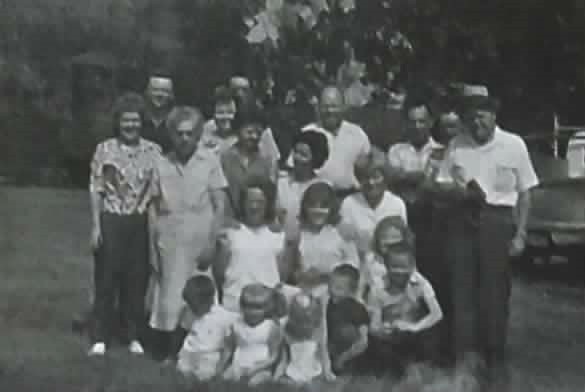
The Eaton clan having a picnic around 1965 or 66

Let the music and dancing begin! Bring out the food and drinks!

And later tonight, the stories will be told. I will listen and pass them on.

Peace

P.S. Read all about my forefathers and mothers at All my Ancestors. Don’t forget to subscribe or otherwise mark this blog as I will be adding more Family Stories this month!